How Much Does Private Tutoring Cost in Australia (2026 Guide)
Discover how much private tutoring costs in Australia in 2026. Compare tutoring rates by year level, subject and format, and learn how to choose the right tutor for your budget.
Private tutoring in Australia typically costs $40–$180 per hour in 2026, depending on the tutor's qualifications, the year level, the subject, and whether sessions are one-on-one, online, or in a small group. University-student tutors sit at the lower end, while qualified teachers and specialist HSC tutors charge more.
This guide breaks down what you can expect to pay by year level, subject and format, explains what drives the price, and shows you how to get genuine value rather than just the cheapest rate.
Tutoring Cost in Australia at a Glance
Here's the quick version. Use it to find your likely range, then read on for the detail behind each one.
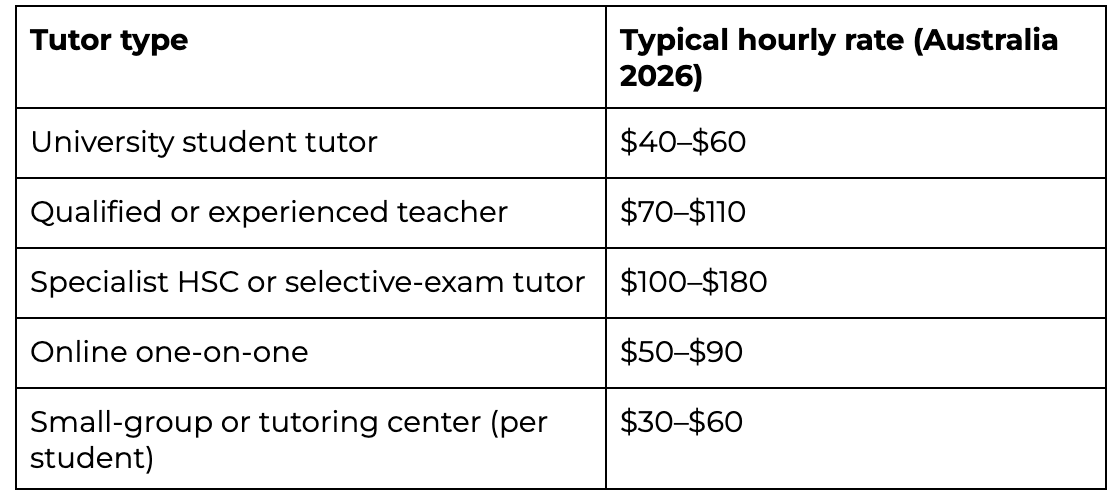
A few things to keep in mind as you read these numbers:
- The hourly rate is only part of the picture. A higher-quality tutor who gets results in fewer sessions can cost less overall.
- In-home tutoring often carries a small premium to cover travel.
- Packages and term blocks usually reduce the per-hour cost compared with one-off sessions.
How Much Does Tutoring Cost by Year Level?
Cost rises with the year level, mainly because the stakes and the subject difficulty rise too.
Primary school tutoring cost
Primary school tutoring typically costs $40–$70 per hour. It usually sits at the lower end of the market because it focuses on building strong foundations in literacy and numeracy. Demand climbs in Years 4–6 as families prepare for Opportunity Class (OC) and selective school placement tests, which can push rates higher.
High school tutoring cost (Years 7–10)
Tutoring for Years 7–10 generally costs $50–$90 per hour. Content becomes more specialised, so subject-specific knowledge starts to matter more. This is often where families invest to fix gaps early, before the senior years.
HSC tutoring cost (Years 11–12)
HSC tutoring is the premium tier, typically $80–$180 per hour. Three factors drive the higher cost:
- High stakes: HSC results feed directly into the ATAR, so the margin for error is small.
- Deep syllabus expertise: Tutors need a thorough understanding of NESA syllabus requirements and marking standards.
- Strong demand: Specialist tutors for high-difficulty subjects like Mathematics Extension are in limited supply.
How Much Does Tutoring Cost by Subject?
Most core subjects sit within the standard range for the year level. Some command a premium because they're harder to teach or harder to find specialists for.
Cost relative to standard: Standard
Why?: Broad pool of capable tutors
Cost relative to standard: Standard
Why?: High demand, good supply
Mathematics Extension 1 & 2
Cost relative to standard: Premium
Why?: Few tutors with the required depth
Sciences (Physics, Chemistry)
Cost relative to standard: Slight premium
Why?: Specialist content, especially at HSC
Languages
Cost relative to standard: Standard to premium
Why?: Depends on the language and level
If your child needs a high-difficulty senior subject, expect to pay toward the top of the relevant range.
One-on-One vs Group vs Online: Cost Comparison
Format is one of the biggest levers on price — and on results. Here's how the three main options compare.

The key point: the cheapest format isn't automatically the best value. A focused one-on-one session can achieve in one hour what a group setting takes several to match. Match the format to the student's needs, not just the price tag.
What Affects the Cost of Tutoring?
Several factors push the price up or down. Knowing them helps you judge whether a quote is fair.
- Tutor qualifications and experience: A registered teacher costs more than a university student and usually delivers results faster.
- Year level and exam stakes: HSC and selective-exam preparation sits at the top of the range.
- Subject specialisation: Harder subjects with fewer available tutors cost more.
- Format and location: In-home tutoring can carry a travel premium; online is often slightly cheaper.
- Session length and frequency: Longer or more frequent sessions may attract a better per-hour rate.
- Casual vs package: Term blocks and packages generally lower the per-hour cost compared with one-off bookings.
Is Private Tutoring Worth the Cost?
For most families, yes, provided you measure value the right way.
The common mistake is comparing tutors on hourly rate alone. A better measure is cost per outcome: how much progress you get per dollar spent, not per hour booked.
Here's the practical way to think about it:
- A $50/hour tutor who needs 20 sessions to lift a grade costs $1,000 for that result.
- A $90/hour tutor who achieves the same in 10 sessions costs $900 and gets there sooner.
The higher hourly rate can be the cheaper, faster path. When you weigh it up, ask what result you're paying for and how efficiently a tutor can deliver it, not just what an hour costs.
How to Choose a Tutor Without Overpaying
You don't need the most expensive tutor. You need the right one for the job. Use these checks.
Questions worth asking
- What are your qualifications and experience with this year level and subject?
- How do you measure and report progress?
- Do you tailor sessions to my child, or follow a fixed program?
- What's included, planning, resources, feedback, in the hourly rate?
Red flags to watch for
- Vague answers about qualifications or results.
- No clear plan for tracking progress.
- Pressure to commit to a large package before you've seen any value.
- A rate that seems too good to be true for the level of support promised.
Why the cheapest option can cost more
A lower hourly rate often means less experience, which can mean slower progress and more sessions. Over a term, that "cheap" tutor can end up costing more than a qualified one with weaker results.
Value vs. Cost: Minimising Your Long-Term Expense
The cheapest hourly rate is rarely the most economical solution over the course of a school year.
The Efficiency Gap
An elite, experienced tutor charging $95 an hour can often diagnose a conceptual bottleneck, deliver a targeted strategy, and resolve a learning gap within 4 to 6 sessions. A cheaper, unvetted tutor charging $45 an hour may take months to achieve the same structural breakthrough due to a lack of pedagogical training.
The True Cost of Volatility
Independent, unvetted tutors often experience high turnover due to shifting university schedules or changing casual work hours. Every time a tutor quits, your child loses academic momentum, stretching out the time and total money required to achieve their target grades.
Get a Clear Quote for Your Child
Every student's needs are different, so the best way to know your exact cost is to start with a conversation. At Erudite Tuition, our pricing architecture is completely transparent. With structured online delivery starting at a predictable $59 per hour, families receive fully managed, curriculum-aligned support with zero hidden travel surcharges, zero contract lock-ins, and a dedicated team managing the educational roadmap.
Schedule a trial lesson and we'll recommend the right tutor, format and plan for your child's year level and goals with transparent pricing and no pressure.
FAQs
How much does private tutoring cost in Sydney?
Private tutoring in Sydney generally costs $40–$180 per hour in 2026. University-student tutors sit at the lower end, while qualified teachers and specialist HSC tutors charge more.
Why does tutoring cost so much?
Tutoring cost reflects the tutor's qualifications and experience, the subject's difficulty, preparation time, and demand. A qualified teacher delivering one-on-one instruction is far more resource-intensive than group help.
Is a qualified-teacher tutor worth the extra cost?
Often, yes. Teacher-qualified tutors understand the curriculum and assessment standards in depth, which can mean faster progress and fewer sessions, frequently lowering the total cost despite a higher hourly rate.
How much does online tutoring cost compared with in-person?
Online tutoring is usually similar to, or slightly cheaper than, in-person tutoring, because there's no travel time or in-home premium while delivering comparable results for most students.
Is group tutoring cheaper than one-on-one?
Yes. Per-student group rates are lower, but one-on-one tutoring offers fully personalised attention. The best value depends on the student's needs, not the headline price.
How many tutoring sessions does a student need?
It varies, but many students see meaningful progress with one to two sessions per week over a term. Consistency matters more than total volume.